
Buckinghamshire Primary Science Conference
February 24, 2027
Time: 9:30am – 4:00pm
Venue: St Clements Dane School, Chorleywood, WD3 6EW
Cost:
- £100 per teacher
- £20 per trainee
- One free place per Science Oxford member school (on either the Oxfordshire and Buckinghamshire Primary Science Conferences)
All primary teachers and trainee teachers across Oxfordshire and Buckinghamshire are welcome to attend.
The Power of Why: Creating a culture where children question, explore and discover
This year’s Buckinghamshire Primary Science Conference promises to be truly inspirational with expert speakers joining us to explore how to harness pupils’ curiosity and creativity to build a science curriculum that ensures all pupils are inspired. Be part of a day dedicated to enriching your approach to primary science and sparking inspiration across your school community. Hear from a diverse line-up of expert speakers offering practical insights and fresh ideas to help you enhance science teaching and learning.
Book Now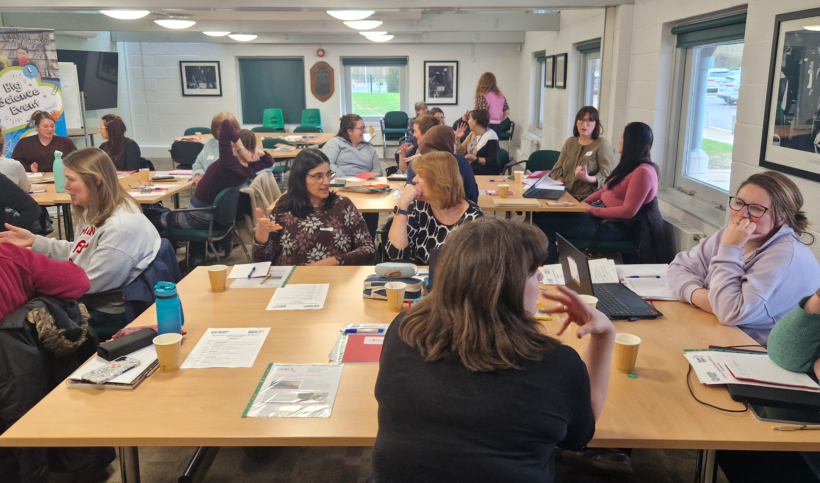
Keynote speakers:
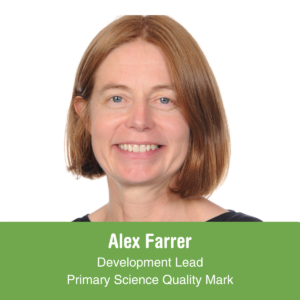
Alex Farrer is a primary science education specialist and Development Lead for the Primary Science Quality Mark, working with hundreds of schools each year, both in the UK and internationally to support the professional development of science leaders and teachers. She has taught in many different schools, leading science and STEAM, and holding various leadership roles as well as having been an LA science advisor for several years. Alex proudly gained PSQM Outreach for her school in 2019 and 2023, won the PSTT Primary Science Teacher Award in 2019 and is an accredited trainer of the Primary Science Capital Teaching Approach. Alex is also the co-author of the PSTT resources “See Through Science” and “Sketchbook Science” and co-developed the unconscious bias materials “Science4Everyone” with the Wellcome Sanger Institute.
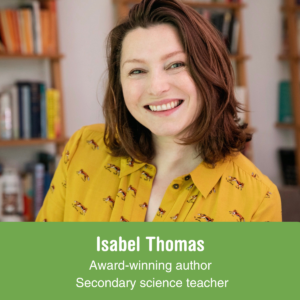
Isabel Thomas is a science writer, secondary science teacher and the award-winning author of more than 300 books for young audiences, including Moth: An Evolution Story and the bestselling Impossible Questions series. Isabel also writes for children’s science magazines and BBC Bitesize, and works with organisations to create science outreach events and resources.
Isabel studied Human Sciences at the University of Oxford and completed her PGCE and an MPhil in Education Research at the University of Cambridge. Having grown up in a low-income, one-parent family, Isabel is passionate about inspiring children from diverse backgrounds to pursue science education and careers.
Workshop leaders:

Dr Rebecca Ellis champions inclusive, purposeful and enjoyable primary science for children and their teachers. She has extensive teaching experience spanning 2000-2025 and became a Fellow of the Primary Science Teaching Trust (PSTT) in 2018. She was part of the Explorify development team (2021-2023), leading the creation of the Inclusion Hub and Climate Challenge collection. Rebecca is now a PSTT Primary Science Mentor, supporting schools and contributing to national webinars and projects, including Thinking, Doing, Talking Science.
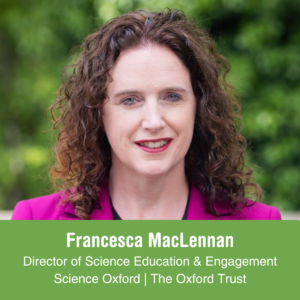
Francesca MacLennan is Director of Science Education & Engagement, leading The Oxford Trust’s education and engagement programmes, under the Science Oxford brand. In her career spanning over 25 years, she has worked in various roles in science education and talent development, including primary science teaching, STEM outreach, professional development and graduate training programmes. As a leader, educator, engagement specialist and training programme builder, as well as a Fellow of the Primary Science Teaching Trust, she has a wealth of experience leading programmes throughout the educational stages, from the early years right through to the postgraduate level.
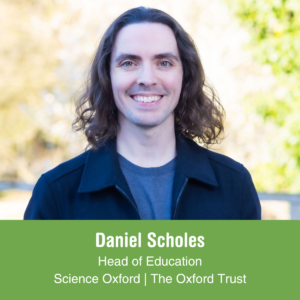
Daniel Scholes is the Head of Education for Science Oxford and oversees three core programmes: the primary school outreach programme, secondary schools STEM Careers Programme and the teacher professional learning programme. Daniel has a BA (Hons) in English from the University of Exeter, and a PCGE with QTS from Oxford Brookes University. Daniel particularly values the ethos of Thinking, Doing, Talking Science, embedded in all aspects of Science Oxford’s work with young people, as it encourages children to explore and test ideas, consider new perspectives, and to share their discoveries with others.
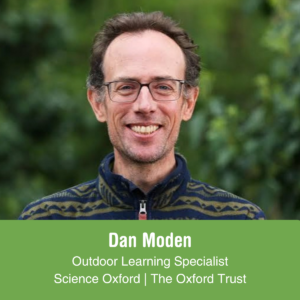
Dan Moden is the Outdoor Learning Specialist at the Science Oxford Centre, where he delivers the primary STEM education programme with a particular focus on developing outdoor learning experiences for pupils, families, and community groups. He works to create engaging, hands-on opportunities that connect young people with science through the natural environment. Dan holds a BSc in Geography from The University of Manchester and spent 17 years teaching in secondary schools. He later moved into environmental education with Wiltshire Wildlife Trust, where he delivered Forest School programmes, practical conservation activities and youth engagement initiatives, building strong links between education and the natural world. Daniel is committed to creating meaningful experiences that inspire curiosity and foster a lasting connection to and care for the natural world.
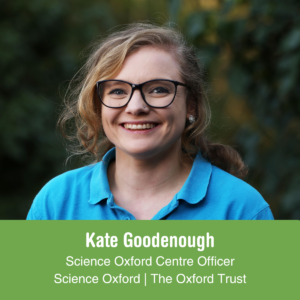
Kate Goodenough is a Science Oxford Centre Officer at Science Oxford and delivers workshops, theatre shows and other activities across the site. She helps develop new content and activities for people of all ages and abilities to enjoy and be involved in. Kate has a Level 3 Diploma in Animal Management from Berkshire College of Agriculture (BCA). Before focusing on science communication, she worked in the zoological industry, providing animal husbandry to a variety of species whilst educating guests about the importance of zoos, sustainability and global conservation.
9.00am: Arrival and Marketplace
9.30am: Keynote address 1
‘Ask like a scientist’
Alex Farrer, Development Lead, Primary Science Quality Mark
Alex will outline the importance of children using their curiosity and interests to ask and answer scientific questions. Going beyond simply encouraging curiosity, strategies to teach children to ask questions, explain their thinking and communicate their ideas using scientific vocabulary will be explored.
10.15am: Workshops
‘Planning Inclusive Primary Science’
Rebecca Ellis, Primary Science Teaching Trust
Why is an inclusive approach needed? We will succinctly review current statistics and guidance around Inclusion and Additional Learning Needs (ALN/ SEND).
What can we do to make our current science curriculum more inclusive? We will explore a simple planning tool based on common barriers children experience in science and share strategies and ideas that support all our science learners. Participants will have the opportunity to start to use the planning tool to review a science topic of their choice.
‘Connecting with nature in schools’
Dan Moden, Outdoor Learning Specialist and Kate Goodenough, Science Oxford Centre Officer, The Oxford Trust
In this practical workshop, we will explore a range of tried and trusted outdoor strategies that promote wellbeing and nature connection. There will be a focus on simple, low-prep, high impact activities adaptable to a range of different settings.
11.15am: Break
11.45am: Workshops
‘Sketchbook Science: Connecting science and art’
Alex Farrer, Development Lead, Primary Science Quality Mark
Sketchbook Science is a set of eight freely downloadable projects developed collaboratively by the science and art leads from 18 different schools to combine learning in both science and art to enhance conceptual understanding and practical skills in both subjects. In this workshop you will have the opportunity to explore the Sketchbook Science resources, developing your knowledge and skills and discussing how cross curricular activities can be used in whole school planning to enhance curriculum design.
‘Supporting children to build their scientific vocabulary’
Rebecca Ellis, Primary Science Teaching Trust
This session builds on guidance from the EEF Improving Primary Science report (2023), exploring how to help children develop scientific vocabulary so they can ‘actively participate in science learning and effectively communicate their understanding’. Participants will try a range of interactive vocabulary games that can be used in the classroom to consolidate knowledge in engaging ways. We will also consider the importance of children being ‘minds on’ as well as ‘hands on’ during practical work and explore strategies to support them communicate their scientific thinking.
12.45pm: Lunch and Marketplace
1.45pm: Keynote address 2
‘Impossible questions’
Isabel Thomas, Author and Secondary Science Teacher
What’s the point of snot? Why is water wet? Are feelings made from atoms? Isabel Thomas has been collecting children’s weird and wonderful questions for more than a decade, and answering them in her bestselling Bedtime Book of Impossible Questions series. She will explore the links between children’s curious conundrums and real-life science, plus the potential for using your pupils’ own ‘impossible questions’ to build science capital in your primary classroom.
2.30pm: Workshops
‘Helping children ask and answer their own impossible questions’
Isabel Thomas, Author and Secondary Science Teacher
In this workshop, Isabel will share an approach she developed and trialed with two multi-academy trusts, for integrating science and literacy in primary classrooms. You will learn how to support pupils to ask their own ‘impossible questions’, research possible answers and scaffold a piece of independent, extended writing. This approach helps build science capital in the primary classroom, showing that STEM is not about factual recall, writing instructions or writing up experiments, but about curiosity, creativity, and imagination.
‘Pupil-led enquiry and the Big Science Event’
Daniel Scholes and Francesca MacLennan, The Oxford Trust
Empowering pupils to effectively ask quality scientific questions and conduct their own investigations which can significantly boost their engagement and motivation in science. This session offers a toolkit of strategies to inspire pupil-led thinking and support teachers in confidently managing practical investigations in the classroom.
3.30pm: Reflections and closing
1) What happens if I can’t make the event anymore?
We will refund you the cost of your booking, excluding the Eventbrite fee, if you let us know that you can no longer attend more than 7 days before the event.
Please note if you are a teacher who has booked a free place on the course, you will be charged a non-attendance fee equivalent to the price of the paid place if you do not cancel your booking at least 7 days before the event.
If you let us know within 7 days of the event, we can transfer your place to another teacher in your school.
2) What should I do if I made a mistake with my booking?
Please get in touch with us at [email protected] and we’ll help you rectify your booking.
3) My school is a member of Science Oxford. How do I book a free place?
Your school has been sent an access code to claim a free member ticket at checkout. If you haven’t received the access code, please get in touch with us at [email protected].